Surfaces our work more for you across Google Search and AI answers.
Quick read: Search Engine Optimization (SEO), Answer Engine Optimization (AEO), and Generative Engine Optimization (GEO) are three names for one connected discipline: making a website easy to read, credible, and quotable. SEO gets a site found on Google's results page. AEO and GEO — which are nearly the same thing — get it cited inside the answers that AI assistants like ChatGPT, Claude, Perplexity, and Google's AI Overviews increasingly return instead of a list of links. The underlying work overlaps heavily: clean structured data, FAQ-formatted answers, an
/llms.txtfile, consistent business information, and answers placed near the top of the page. None of it requires a monthly agency retainer.
For twenty years, "rank on Google" was the whole game.
That game is still on. It's still where most traffic comes from. But somewhere in the last two years, three new acronyms showed up to the party, and at least one of them arrived with a price tag designed to make you flinch. SEO you've heard of. AEO and GEO are newer, and depending on which cold email landed in your inbox this week, you've been told they're either the future of marketing or a scam.
They're neither. They're mostly the same job SEO always was, retargeted at machines that answer instead of list. Here's how the three fit together — and why you almost certainly don't need to pay four figures a month for any of it.
The three acronyms, spelled out once
Search Engine Optimization (SEO) is the practice of convincing Google's ranking algorithm that your page deserves to appear when someone searches. Keywords, backlinks, page speed, content depth, structured data. The user sees a list and chooses. This is the foundation, and it isn't going anywhere.
Answer Engine Optimization (AEO) is the practice of getting your site quoted when an AI assistant answers a question. The user sees a paragraph — maybe with a couple of source links — and often never loads a results page at all. AEO is about being citable, not just findable.
Generative Engine Optimization (GEO) is, for practical purposes, the same job as AEO. GEO is the broader label that's gaining traction with agencies; AEO emphasizes question-answering tools specifically. The terms are used interchangeably, and the underlying work is nearly identical. If a salesperson tells you GEO is a separate, more expensive discipline than AEO, they're describing their pricing, not the technique.
So: one foundation (SEO) and one new layer with two names (AEO / GEO). That's it. The rest of this post treats AEO and GEO as a single body of work, because that's what they are.
SEO: the foundation that still does the heavy lifting
None of the AI stuff works on a broken site. An AI assistant that can't crawl your pages, can't parse your content, and can't tell what your business does will not cite you — for the same reasons Google won't rank you.
So the foundation is unglamorous and unchanged: a fast, crawlable, technically clean site; content that answers the questions people search for; a coherent and consistent web presence; and a real robots.txt and sitemap.xml so crawlers can find everything instead of treating your site like a corn maze. Strong SEO fundamentals quietly improve AEO too, because AI systems prefer to quote sources that are already trusted and well-organized. Skip the foundation and the rest is decoration on a house with no plumbing.
AEO: formatting your content to be quoted
Here's where the work diverges. SEO-focused content is written to rank. AEO-focused content is written to be quoted — and an AI quotes declarative sentences, not marketing.
"We strive to deliver excellence" is not citable. "We build and maintain custom websites for US-based small businesses, with ongoing monthly care handled by one person" is. The first is a brochure. The second is a sentence an AI can lift, attribute, and put in front of a customer.
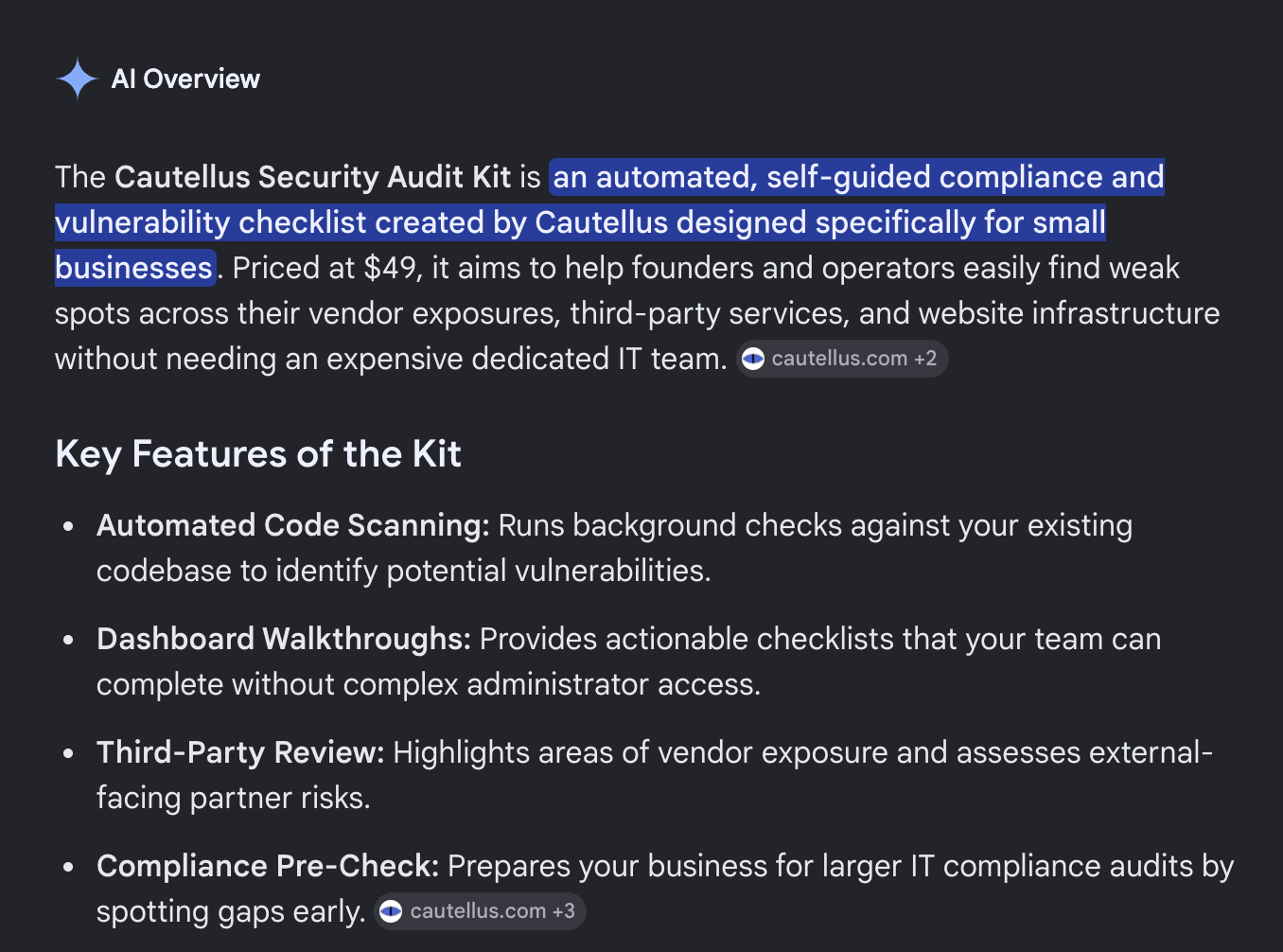
Real AI Overview — cautellus.com cited as the source on a query about its Security Audit Kit. This is what "being the answer" looks like in production.
The formatting work that gets you there:
- FAQ-style answers near the top. Questions as explicit headings, each followed immediately by a direct, complete answer in the first sentence or two — not a build-up to the answer in paragraph six. AI systems that retrieve content in real time scan for direct answers; they don't read patiently. The "Quick read" block at the top of this post is a worked example of the pattern.
- Schema.org markup on every relevant page —
Organization,Service,LocalBusiness,FAQPage,Article— so machines can parse what a page is about without guessing. It's invisible to humans and decisive for AI. - Semantic clarity. Plain, factual sentences over hedging and marketing fog. The answer first.
GEO: building the authority that makes AI trust you
Formatting gets you readable. Authority gets you chosen. When an AI decides which two or three businesses to name in an answer, it's making a credibility judgment — and that judgment runs on signals you control:
- Consistent business data everywhere it appears. If your website says "123 Main Street, Suite 4," your Google Business Profile says "123 Main St Ste 4B," and Yelp says "uhhh, downtown," the AI is working with conflicting signals and tends to favor whoever wasn't sloppy. This single inconsistency is often the reason a business shows up in the traditional local pack but vanishes from AI Mode results for the same query.
- A clean
/llms.txtfile. The AEO equivalent ofrobots.txt— a plain-text file at your site's root that tells AI crawlers what you've got and in what order to read it. Written like a host briefing a guest rather than yelling at a contractor. It's low-effort and underused enough to still function as a minor differentiator. - Entity clarity and reputation. Unambiguous information about who you are, where you operate, and what you've done, backed by reviews and mentions from credible sources. Google's own guidance on what earns AI citations keeps pointing back to accurate structured data and genuine authority.
Gartner predicted in a February 2024 press release that traditional search engine volume would drop 25% by 2026 as users shifted to AI tools. Whether that exact figure lands on schedule or over a longer curve, the direction isn't in dispute — and the zero-click era was already shrinking organic traffic before AI Overviews arrived.
The same query, run through both machines
Take a plumber in a mid-sized city. The query: "best plumber in [city]."
In traditional Google search, a local pack appears — three businesses, a map, ratings, phone numbers — and below it, organic results: directories, review sites, and the plumber's own site if it's well-optimized. Whether they make the map pack depends on Google Business Profile completeness, review count and recency, proximity, and on-page SEO. Known, documented work.
In ChatGPT, Perplexity, or a Google AI Overview, the AI generates an answer that might name two or three plumbers with brief descriptions — "well-reviewed, handles emergency calls, family-owned" — pulled from the plumbers' own sites and review aggregators. Whether this plumber gets named depends on whether their site gave the AI something concrete to quote.
Same query. Two machines. The SEO machine asks, is this page relevant and authoritative enough to rank? The AEO machine asks, is this a source I can confidently cite? Related questions, different standards — and most small business sites have answered only the first.
What agencies sell — and what it costs
Full-service GEO retainers start in the low-to-mid four figures per month — more than many small businesses spend on an entire website redesign, billed every month. The work inside those retainers is the same checklist above: schema audits, content restructuring, /llms.txt, NAP consistency, citation monitoring, and reporting.
That's legitimate work. The question is whether you need an ongoing high-cost retainer to get it, or whether you need someone to set it up correctly and maintain it as part of managing your site. For most small business sites, it's the second one. The gap between "paid a premium monthly retainer" and "had it done as part of normal site maintenance" is mostly labor and packaging, not secret method.
The checklist, if you want to hand it to someone
- Schema markup on every meaningful page —
Organizationsite-wide,Service/Producton offerings,LocalBusinessif you serve an area,FAQPageon Q&A content,Articleon posts. - FAQ content written for machines, not marketing — real questions, answered in plain declarative sentences, the answer first.
- A clean
/llms.txt— your reading list for AI crawlers. - Consistent business data everywhere — name, address, phone, and core description matching across your site, Google Business Profile, and every directory.
- Answers near the top — the most citable sentence on each page should appear early, not buried.
Most sites have done none of this. That's not a criticism — the category barely had a settled name a year ago. But it's also the whole opportunity: every month a competitor delays is a month their listing isn't mentioned when somebody asks an AI for a recommendation. Early structural work compounds, because the systems training on that data keep reinforcing what they already found credible.
If your site already has solid SEO fundamentals, most of the AEO and GEO layer is structural work on top of what's already there. On a managed Care plan it's part of what gets reviewed and maintained — and the sample report shows exactly what that looks like month to month. Care starts at $199/mo, month-to-month, and ships SEO, AEO, and GEO together, because pretending they're three separate products is how the four-figure retainers happen.
FAQ
What is the difference between SEO, AEO, and GEO?
Search Engine Optimization (SEO) optimizes a site to appear in Google's ranked list of results. Answer Engine Optimization (AEO) optimizes a site to be cited inside AI-generated answers from tools like ChatGPT, Perplexity, Claude, and Google's AI Overviews. Generative Engine Optimization (GEO) is, for practical purposes, the same discipline as AEO — a broader label for the same work. SEO gets you found; AEO and GEO get you quoted. The requirements overlap heavily, but AEO/GEO add a layer — structured data, FAQ formatting, /llms.txt, and consistent entity information — that classic SEO doesn't fully cover.
Are AEO and GEO the same thing?
Essentially, yes. The terms are used interchangeably and the underlying work is nearly identical. Answer Engine Optimization tends to emphasize question-answering contexts specifically; Generative Engine Optimization is the broader umbrella term for optimizing toward any generative AI system. We treat them as one discipline with slightly different emphasis. Anyone selling GEO as a separate, pricier service than AEO is describing their pricing, not a different technique.
Does AEO or GEO replace SEO?
No. Traditional organic search still drives the majority of website traffic for almost every small business, and Google's blue links aren't disappearing on any near-term timeline. AEO and GEO are a layer on top of an SEO foundation — the same discipline of making a site technically sound and content-clear, applied to the growing share of queries that route through AI tools. The businesses best positioned for the shift are doing both, not choosing between them.
Do I need to hire a GEO agency?
No. The core work — schema markup, FAQ content, /llms.txt, consistent business data, and direct-answer page structure — is implementable by any competent developer or managed website provider and maintainable as part of normal upkeep. Agencies charge mid-four-figure monthly retainers for it. For most small businesses, a correct one-time implementation plus regular maintenance is more appropriate than an ongoing agency engagement.
How do I know if my site is being cited by AI?
Check manually. Open ChatGPT, Claude, Perplexity, and Google AI Mode and ask the questions a customer would ask about your category and location. If the answer names you, you're being cited. If it names a competitor and not you, you're losing those conversations silently. Dedicated citation-tracking tools exist — Profound is among the most referenced — but the manual check is free and surprisingly clarifying.
How long does this take to start working?
Indexing changes show up in Google within days to a few weeks after crawlers re-read the site. Citation patterns in AI tools move on each system's own retrieval and training schedule, which varies and isn't publicly documented — sometimes weeks, sometimes longer. This is a compounding play, not an overnight one: the schema, structure, and content live in place and pay off increasingly as more searches route through AI front-ends. Expect a six-to-twelve-month curve, not a switch.
Can someone guarantee my business gets cited by AI?
No, and anyone promising it is either confused or scamming. AI assistants choose what to cite based on their own retrieval and ranking, which no third party controls. What a credible operator can guarantee is the work — schema, structure, clarity, consistent data — that maximizes the odds. If a sales pitch includes the words "guaranteed AI placement," close the tab.
What is /llms.txt and do I need it?
/llms.txt is a plain-text file at the root of a site that tells AI crawlers what content the site contains, in what order of importance, and how to interpret it — the AEO equivalent of robots.txt. It isn't required by anyone yet, but it's an early-mover signal: the sites adopting it now are the ones these systems are more likely to be pre-trained to quote later. Get the SEO and AEO fundamentals in place first; once they are, it's a low-cost addition worth making.
Want a back office for your site?
The build is free on any Care plan with a 12-month minimum. Care starts at $199/mo, and you can switch tiers anytime.
Apply for a build slot →RELATED READS