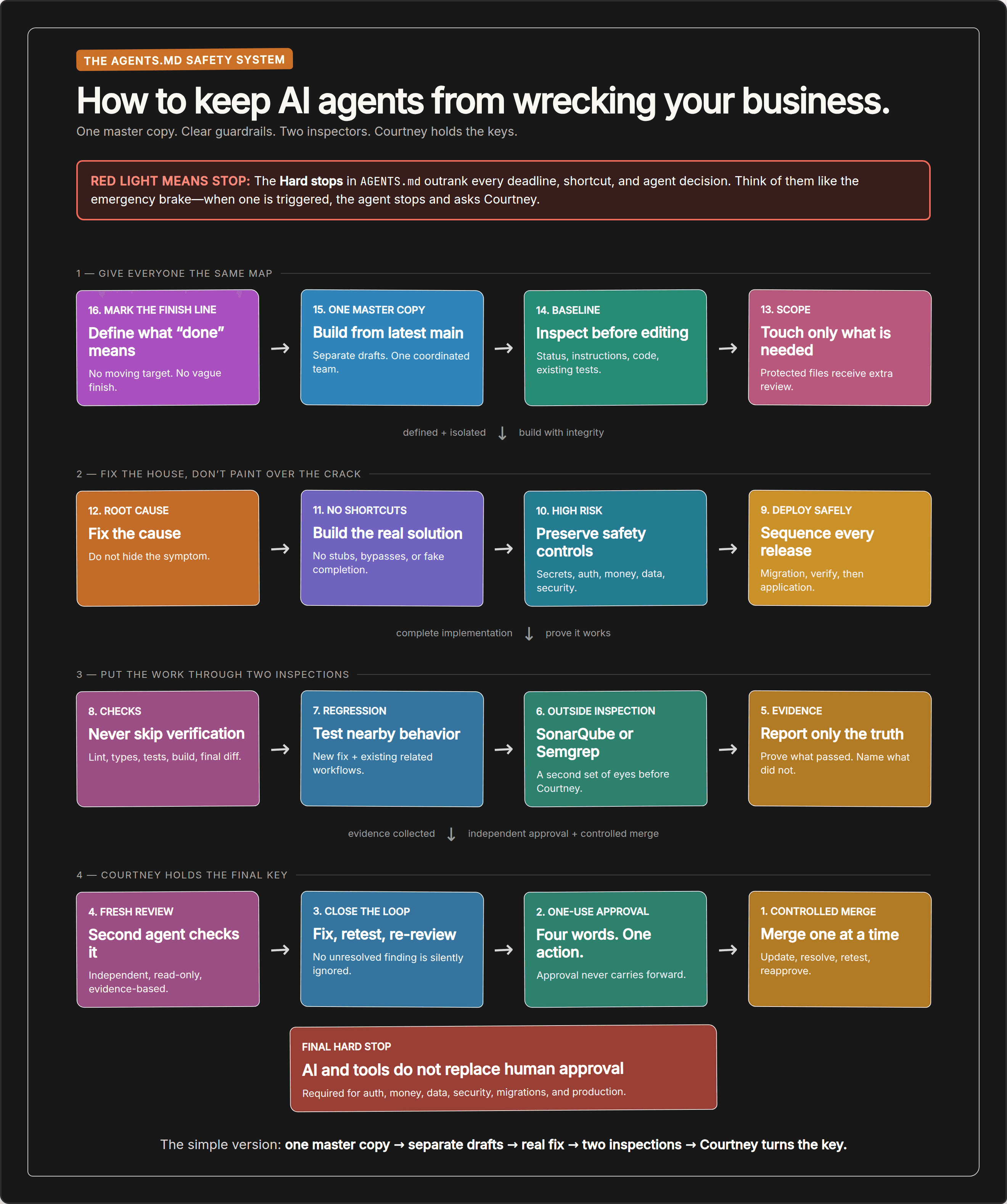
The AGENTS.md safety system
How to keep AI agents from wrecking your business.
One master copy. Clear guardrails. Two inspectors. Courtney holds the keys.
Click a colored block to explain it ↓
1 — Give everyone the same map
2 — Fix the house, don’t paint over the crack
3 — Put the work through two inspections
4 — Courtney holds the final key
Shared AGENTS.md rules — identical across all ten repos
Tier 1 — Hard stops approval required every time
Git
claude/ branch only · Show diff, then stop · Never force-push main · Stage explicit paths · Don’t touch others’ branches · Uncommitted work → stop
Deploys + database
Push is the deploy · No production deploys, promotes, or rollbacks · Write migrations, don’t run them · No schema changes · Reads are fine; writes need approval · Never edit a shipped migration
Secrets + money
Never print secrets · Never rotate credentials · Never edit .env in place · Stripe test mode only · No live payments
Deletion + customer data
No rm -rf or DROP · Deactivate, don’t delete · Never touch real personally identifiable information · Synthetic fixtures only
Sending + spending
Never send to real addresses · No manual cron fires · No paid API without approval
Routines + incidents
Edit the file, not the trigger · Stop and report incidents; don’t self-fix
Approval + scope
Four words count as approval · Approval applies once to one action · Not in plan → ask · Not in docs → ask
Think red traffic light: nobody gets to decide it is inconvenient and drive through it.
Tier 2 — Code review gate always in this order
1. Automated review
SonarQube for 2 designated repos. Semgrep for the other 8 repos.
2. Human review
Show Courtney the final scoped diff, test evidence, regression results, scanner findings, and remaining risk.
3. Push approval
Courtney reviews and explicitly says push. Until then, stop.
Think home inspection: the builder checks the work, an outside inspector checks it again, then the owner accepts the keys.
Tier 3 — Medium risk ask first
Stack + claims
Stack is locked · No new dependencies · No fabricated statistics · No ranking or revenue guarantees
Identity + her documents
First name only · Never rewrite her .md · Quote, propose, wait
Diff + infrastructure
Stay inside the diff · One concern per commit · No side-effect infrastructure
Search Engine Optimization + legal
Ask before robots, canonicals, or redirects · Regulated text is propose-only
No overlapping elements · SAFE_BOTTOM = 36pt · Render and check every page
Think permission fence: the agent can see the next yard, but it must ask before stepping into it.
Tier 4 — Low risk just do it this way
Commands
Run lint, build, and tests · Use newest Python · Never claim an unrun check
Conventions
Use docs/ and scripts/ · One concern per file · Commit message via a -F file
Reporting + voice
Every task ends with a summary · Tone and voice are specific to each property
Think closing checklist: routine steps happen every time so nothing small is forgotten.
Only one section changes by repository: “This repo specifically.” Everything above stays shared across all ten repos.
The simple version: one master copy → separate drafts → real fix → two inspections → Courtney turns the key.